Click here to download whitepaper

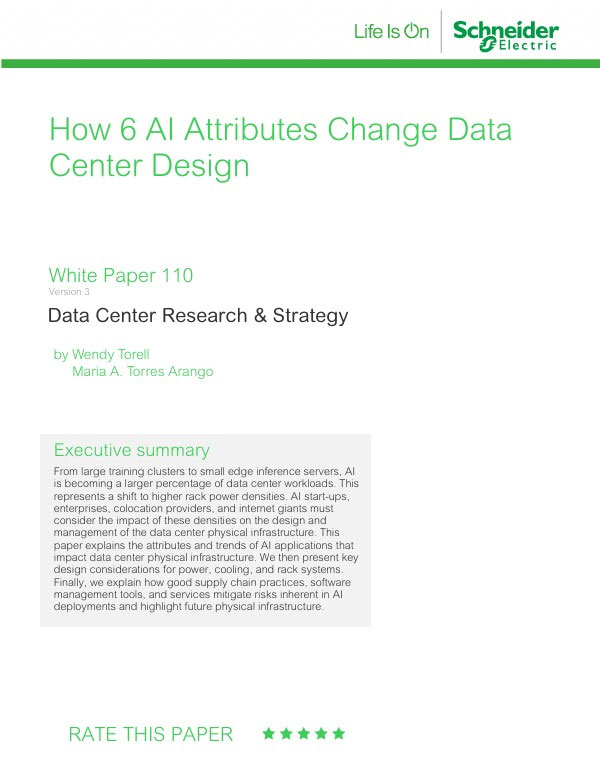
How Six AI Attributes Are Changing Data Centre Design

AI is taking up a growing share of data centre workloads, from large training clusters to small inference deployments, and it is pushing rack densities well beyond what most facilities were built for. The white paper identifies six attributes of AI workloads that drive this change and sets out what they mean for power, cooling, racks, supply chain and day-to-day operations.

It is written for CIOs, infrastructure and facilities teams, data centre operators and consultants planning to host AI in new or existing sites. Advanced Power Technology helps organisations plan and deliver AI-ready environments through its data centre design and build services.

Six attributes that drive density and power anomalies

The report groups the pressures into six attributes: the type of AI workload, accelerator network communication, the thermal design power (TDP) of accelerators, their peak power, synchronous computation and AI cluster size. Training workloads run many accelerators in parallel at high utilisation for hours or months, while inference servers multiply as users and queries grow. Because communication between accelerators is a bottleneck, and short copper links within a rack are cheaper and faster than fibre between racks, there is a strong incentive to pack as many accelerators into each rack as possible.

Accelerator power is also rising with each generation. Table 2 in the white paper shows GPU TDP climbing from 300 W to 1,400 W across five generations. The result is AI compute racks above 100 kW, compared with the 10-20 kW peak that most traditional data centres can support.

Power procurement and distribution both need rethinking

Large training campuses need hundreds of megawatts, and the report points to grid connection queues of 3-5 years in energy-constrained regions, making early power planning, including on-site generation, a necessity. Inside the facility, accelerators can exceed their TDP by around 50% for tens of milliseconds, and in training clusters these peaks happen at the same moment across every server. Traditional designs rely on loads being diversified so that UPS and cooling capacity can be oversubscribed. Synchronised step loads remove that margin. Existing sites will need larger power blocks, in some cases higher distribution voltages, and closer attention to arc flash hazards.

Liquid cooling becomes the practical route

Air can cool high-TDP chips in principle, but only with taller heat sinks and therefore taller servers. The example on page 10 of the white paper shows a 42U rack holding 32 GPUs in air-cooled 10U servers, compared with 168 GPUs in liquid-cooled 2U servers. Direct-to-chip cooling brings its own demands: tighter control of coolant temperature, flow and chemistry, a coolant distribution unit to separate facility water from the server loop, and integration challenges caused by the lack of industry standards. The report recommends a design assessment of the planned liquid-cooled loads and the existing facility before any deployment.

Racks, floors and cabling must be specified for heavier loads

High-density AI racks can weigh over 1,800 kg. The report recommends racks at least 750 mm wide, 1,200 mm deep and 48U high, with a static capacity above 2,270 kg and dynamic capacity above 1,600 kg, validated by an independent third party. Concrete slab floors should be checked for loads over 3,000 kg, and high-temperature C21/C22 connectors are advised where rack temperatures exceed the rating of standard C19/C20 connectors.

Supply chain, software and services reduce risk

With lead times lengthening, the report advises specifying physical infrastructure alongside the IT stack, using standardised and prefabricated sub-assemblies, and working with fewer, well-established suppliers. Before retrofitting, a feasibility study using power monitoring (EPMS) and DCIM should establish actual peak draws and spare capacity, followed by capacity analysis, protection coordination, arc flash and short-circuit studies. Once live, a digital twin of the IT space helps operators avoid tripped breakers, hot spots and stranded capacity as safety margins shrink. The paper ends with a look at emerging technologies, including medium voltage distribution in the IT space, solid state transformers and circuit breakers, and higher-voltage racks.

How Advanced Power can help

Advanced Power supports each of these steps, from feasibility and design guidance to liquid cooling solutions for high-density racks and power monitoring that shows real peak demand before new loads are added. For operators adapting existing sites, the related guides on retrofitting power systems for AI clusters and liquid cooling architectures for AI workloads go into more depth.

Planning to host AI workloads in a new or existing data centre? Speak to Advanced Power Technology about power, cooling and rack infrastructure built to support them.